Today, we finish up our seminar on Chicago's religious history by focusing on a history that is still being written. As we discussed last week, the Immigration Act of 1965 radically changed not only the number of people who immigrated into the United States, but also where people were immigrating from. Where northern and southern Europeans had been the most prominent immigrant groups throughout for over a century, immigrants from Asia and Latin America swiftly became most prominent in the years after the Immigration Act.
Today, we'll conclude with one particular tale of this ongoing demographic revolution. Eboo Patel's memoir Acts of Faith is in part a Chicago story, but it's also a story of many of the themes and issues we've confronted here. Today--and REMEMBER we're meeting in room B91--we'll use Patel's memoir as a way to see what has changed and what has stayed the same in Chicago's 100 years of religious history. What has the city constant done to religion? What has religion constantly done to the city?
Thursday, November 18, 2010

Thursday, November 4, 2010
A Theology of the Streets
 |
| Soul and Food in Chicago, c. 1940s |
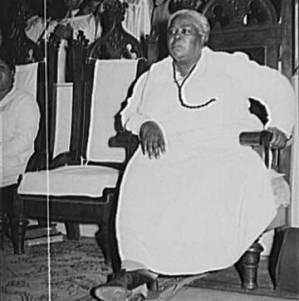 |
| Elder Lucy Smith, c. 1940s |
Wednesday, October 20, 2010
Bibles and Ballots
Last week we looked at a strain within American Protestantism who thought the traumas of urban-industrial life in places like Chicago necessitated religion adapt and be made new to remain relevant. This week, we're looking at another strain in American Protestantism who thought those same changes demanded religion hold on even stronger to its traditional beliefs. We'll be talking about a couple of different facets of American evangelicalism and fundamentalism, but none is more more visually entertaining than the animated preaching of Billy Sunday. Here are some of the few videos taken of the preacher before his death.
Tuesday, October 12, 2010
Christ the Carpenter
As we discussed last week in our comparison of Catholic parishes and Jewish synagogues, the ccentral working theme for the class has emerged. The enormity, the complexity, the diversity and the insanity of the city of Chicago forced religious communities to make certain adaptions to survive urban life. And as we saw, these adaptions were not always welcomed. For our discussion of Protestants in the city, we'll be spending two weeks discussing the kinds of adaptions and reactions churches went through in engaging the city--adaptions and reactions that in many ways continue to influence today's culture wars.
We begin with the emergence of a "Social Gospel" among liberal Protestant theologians at the turn of the twentieth century. The University of Chicago was one of the most important intellectual centers for the social gospel movement, and we'll be reading a central text by University of Chicago theologian Shailer Mathews. Read pages 24-35.
 And then we'll discuss one of these Social Gospel ideas in practice with the Chicago Commons. The organization is actually still in existence, but the original building run by Graham Taylor at Grand and Morgan stands in disrepair.
We begin with the emergence of a "Social Gospel" among liberal Protestant theologians at the turn of the twentieth century. The University of Chicago was one of the most important intellectual centers for the social gospel movement, and we'll be reading a central text by University of Chicago theologian Shailer Mathews. Read pages 24-35.
 And then we'll discuss one of these Social Gospel ideas in practice with the Chicago Commons. The organization is actually still in existence, but the original building run by Graham Taylor at Grand and Morgan stands in disrepair.
Saturday, October 9, 2010
God in America on PBS
As per our discussion of the "God in America" series forthcoming on PBS, here is the information for those of you that are interested.
The series' Website, with information on show times and episode summaries, is here.
And here is the extended trailer for the event.
The series' Website, with information on show times and episode summaries, is here.
And here is the extended trailer for the event.
Wednesday, October 6, 2010
From Shtetl to the City
Chicago's rich and lengthy Jewish history is perhaps the most overlooked aspect of the city's religious history. But in 1900 Chicago's Jewish population was the third largest in the United States at over 60,000 and nearly equaled the Jewish population of Berlin. This session on Jewish Chicago will continue our focus on the local realities of Chicago's religious history, but will also consider the traumas of international immigration as well as the internal diversity of a specific religious group. The only reading for this week available online is Rabbi Emil G. Hirsch's address "The Concordance of Judaism and Americanism."
A central focus of this meeting will be the Jewish community and market that emerged--partly by choice, partly by force--around Maxwell Street. While the city's Jewish history might be understudied, the Chicago Jewish Historical Society remains a premier repository for Chicago Judaica. And while Maxwell Street is now more known as the birthplace of the blues as opposed to Chicago's earliest Jewish community, the Street's Jewish heritage lives on with the aptly named musical group: the Maxwell Street Klezmer Band! Take a Listen:
A central focus of this meeting will be the Jewish community and market that emerged--partly by choice, partly by force--around Maxwell Street. While the city's Jewish history might be understudied, the Chicago Jewish Historical Society remains a premier repository for Chicago Judaica. And while Maxwell Street is now more known as the birthplace of the blues as opposed to Chicago's earliest Jewish community, the Street's Jewish heritage lives on with the aptly named musical group: the Maxwell Street Klezmer Band! Take a Listen:
Thursday, September 30, 2010
Immigrant City, Catholic City
The history of American Catholicism is, at its core, an urban history. Gothic steeples overshadowing dense neighborhoods are a hallmark of the landscape of America's cities. But as we'll discuss in our reading of Studs Lonigan and the parish history of Holy Family Parish, there is more to the urban nature of American Catholicism than its architecture. For these churches embodied and represented a profound sense of community and place that not only shaped America's Catholics but America itself. To compliment our readings, below are three videos from the Chicago History Museum's "Catholic Chicago" exhibit from a few years ago. What themes are repeated here? Do we hear a little Studs Lonigan here?
And we'll conclude today by discussing the changes in both Chicago and American Catholicism is the years surrounding World War I. These changes would mark American Catholicism throughout the remainder of the twentieth century and would especially shape the experience of new Catholic Hispanic immigrants in the late twentieth century. Here is a brief view of the 1926 Eucharistic Congress I'll be discussing.
Catholic Chicago - Parish Life from Chicago History Museum on Vimeo.
Catholic Chicago - Growing Up Catholic from Chicago History Museum on Vimeo.
And we'll conclude today by discussing the changes in both Chicago and American Catholicism is the years surrounding World War I. These changes would mark American Catholicism throughout the remainder of the twentieth century and would especially shape the experience of new Catholic Hispanic immigrants in the late twentieth century. Here is a brief view of the 1926 Eucharistic Congress I'll be discussing.
The Eucharistic Congress - Chicago 1926 from Chicago History Museum on Vimeo.
Subscribe to:
Posts (Atom)